Support Email : [email protected]
  Kottayam, Ernakulam, Trivandrum, Tamil Nadu Support Email : [email protected] Kottayam, Ernakulam, Trivandrum, Tamil Nadu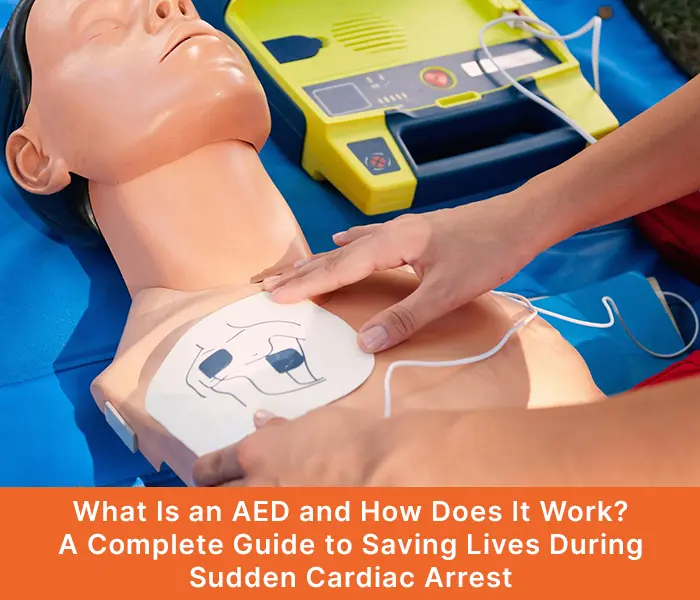
Every second matters when someone experiences a sudden cardiac arrest (SCA). Without immediate intervention, survival chances decrease by approximately 7–10% for every minute that passes without CPR and defibrillation. This is why an Automated External Defibrillator (AED) has become one of the most important life-saving devices in homes, workplaces, schools, airports, hospitals, sports facilities, and public spaces worldwide.
An AED is designed to help ordinary people and healthcare professionals respond confidently during a cardiac emergency. When used together with high-quality CPR, an AED can significantly improve survival rates by restoring a normal heart rhythm before advanced medical help arrives.
At IIEMS (International Institute of Emergency Medical Services), empowering individuals with internationally recognized emergency response training is at the heart of our mission. Through American Heart Association (AHA) courses such as Heartsaver First Aid CPR AED, BLS, ACLS, PALS, and other emergency care programs, IIEMS equips healthcare professionals, first responders, corporate teams, and the general public with the practical skills needed to save lives.
An Automated External Defibrillator (AED) is a portable electronic medical device that analyzes the heart's electrical activity and delivers a controlled electric shock if necessary.
The purpose of the shock is to stop dangerous abnormal heart rhythms such as ventricular fibrillation (VF) or pulseless ventricular tachycardia (VT), allowing the heart's natural rhythm to restart.
Unlike many medical devices, AEDs are specifically designed to be simple enough for trained laypersons to use safely. The device provides clear voice prompts and visual instructions throughout the rescue process.
What Is Sudden Cardiac Arrest?
Many people confuse a heart attack with sudden cardiac arrest, but they are not the same.A heart attack occurs when blood flow to part of the heart muscle is blocked. A sudden cardiac arrest (SCA) occurs when the heart suddenly stops pumping blood effectively due to an electrical malfunction.
Signs of sudden cardiac arrest include:
- Sudden collapse
- Unresponsiveness
- No normal breathing or only gasping
- No detectable pulse (for trained responders)
Without immediate CPR and defibrillation, sudden cardiac arrest is often fatal within minutes.
One of the biggest advantages of an AED is that it guides the rescuer step by step.
Step 1: Turn on the AED
Open the device and press the power button (or open the lid, depending on the model). Voice prompts immediately begin instructing the rescuer.
Step 2: Attach the Electrode Pads
Expose the patient's chest and place the adhesive pads exactly as illustrated on the package:
One pad on the upper right side of the chest
One pad on the lower left side below the armpit
For children, pediatric pads should be used whenever available.
Step 3: Heart Rhythm Analysis
The AED automatically analyzes the heart rhythm.
During this step:
Nobody should touch the patient.
The device determines whether a shock is needed.
Step 4: Shock Delivery
If a shockable rhythm is detected, the AED charges automatically.
The rescuer ensures everyone is clear of the patient before pressing the shock button (or the device delivers the shock automatically in fully automatic models).
Step 5: Resume CPR
Immediately after the shock—or if no shock is advised—the AED instructs the rescuer to begin CPR.
The cycle of CPR and rhythm analysis continues until emergency medical personnel take over or the patient regains signs of life.
One of the most common misconceptions is that only doctors or nurses can operate an AED.
In reality, AEDs are designed for:
- First responders
- Security personnel
- Coaches
- Fitness trainers
- Airline staff
- Police officers
- Firefighters
- Industrial workers
- Healthcare professionals
Members of the public who have received CPR-AED training
With proper training, anyone can confidently use an AED during an emergency.
Time is the single most important factor during sudden cardiac arrest.
Immediate CPR helps circulate oxygen-rich blood to the brain and vital organs, while early defibrillation restores a normal heart rhythm when appropriate.
The "Chain of Survival" emphasizes:
- Early recognition
- Immediate CPR
- Rapid defibrillation
- Advanced emergency care
- Post-cardiac arrest treatment
Using an AED within the first few minutes dramatically increases the chances of survival.
Today, AEDs are recommended in locations where large numbers of people gather.
Examples include:
- Corporate offices
- Educational institutions
- Shopping malls
- Airports
- Railway stations
- Hotels
- Hospitals
- Factories
- Construction sites
- Sports complexes
- Gyms
- Community centers
- Religious institutions
- Residential communities
Having trained personnel alongside an accessible AED creates a safer environment for everyone.
Are AEDs Safe?
Yes. Modern AEDs are extremely safe because they only deliver a shock when a shockable rhythm is detected.
The device will not deliver a shock if it is unnecessary. Its built-in computer continuously analyzes the patient's heart rhythm, minimizing the possibility of user error.
Myth 1: Only doctors can use AEDs.
Fact: Anyone trained in CPR-AED can safely use one.
Myth 2: AEDs always give a shock.
Fact: They only shock when medically necessary.
Myth 3: AEDs can restart a stopped heart.
Fact: AEDs treat specific abnormal heart rhythms. They do not "restart" a heart that has no electrical activity.
Myth 4: CPR alone is enough.
Fact: CPR and AED use together provide the best chance of survival in sudden cardiac arrest.
The Importance of CPR Alongside AED Use
An AED does not replace CPR.
- High-quality CPR:
- Maintains blood circulation
- Delivers oxygen to vital organs
- Increases the effectiveness of defibrillation
- Improves survival outcomes
Every workplace, school, healthcare facility, and public institution should encourage CPR-AED education among staff.
Knowing how to use an AED is not just a professional skill—it is a life skill.
IIEMS is dedicated to developing highly skilled emergency responders through internationally recognized training programs in emergency medicine, trauma care, disaster management, and life support education. The institute offers globally respected certifications, including American Heart Association Heartsaver First Aid CPR AED, BLS, ACLS, PALS, along with EMT and other emergency response programs that prepare participants to respond confidently during real-life emergencies.
Whether you are a healthcare professional, corporate employee, student, educator, industrial worker, or community volunteer, learning CPR and AED skills empowers you to make a life-saving difference when every second counts.
An Automated External Defibrillator is one of the simplest yet most powerful devices in emergency medicine. Combined with early recognition of sudden cardiac arrest and immediate CPR, an AED can transform a bystander into a lifesaver.
Preparedness saves lives. Investing in CPR-AED training not only enhances workplace and community safety but also builds the confidence to act during critical moments. If you are looking to develop internationally recognized emergency response skills, IIEMS provides world-class training that equips individuals and organizations to respond effectively when it matters most.