Support Email : courses@iiems.in
  Kottayam, Ernakulam, Trivandrum, Tamil Nadu Support Email : courses@iiems.in Kottayam, Ernakulam, Trivandrum, Tamil Nadu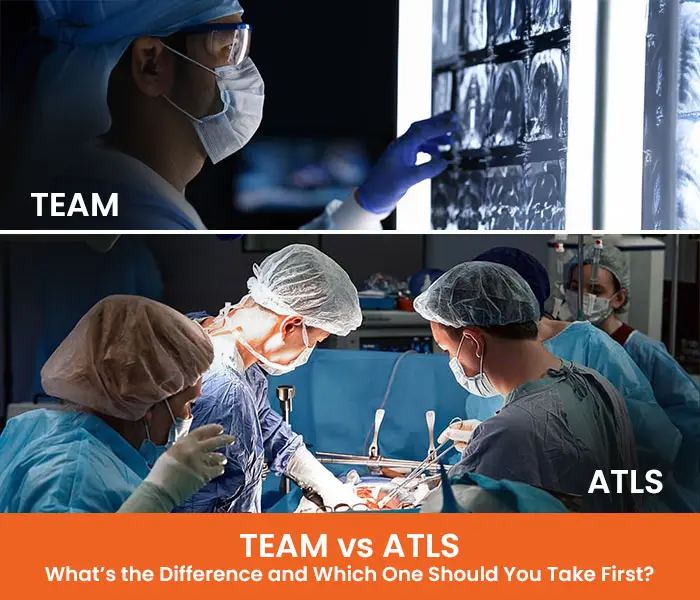
That’s why structured training programs are essential in preparing healthcare professionals to assess and manage trauma cases with confidence, clarity, and competence.
Emergency medicine thrives on structured protocols, teamwork, and decisive action. Two cornerstone courses that serve this mission are:
Both played pivotal roles in shaping trauma care worldwide. Both courses are backed by the American College of Surgeons (ACS) and are designed to improve trauma care outcomes. However, they cater to different levels of experience, with distinct content, formats, and purposes.
TEAM stands for Trauma Evaluation and Management. It is a foundation-level course designed primarily for:
Developed by the American College of Surgeons, TEAM provides an introductory look into the structured approach to trauma patient management. The course is typically completed in a single day and includes:
It focuses on teaching the ABCDE approach (Airway, Breathing, Circulation, Disability, Exposure) and emphasizes the importance of a systematic primary and secondary survey. TEAM also encourages effective teamwork, communication, and a strong understanding of one’s role in the trauma team.
ATLS, or Advanced Trauma Life Support, is a globally recognized course created by the American College of Surgeons to train doctors in the early management of trauma patients.
It is targeted towards:
ATLS is an intensive three-day course that includes:
The focus of ATLS is not just on understanding the trauma process but on decision-making and life-saving interventions during the "Golden Hour" after injury. ATLS equips participants with the tools to rapidly assess a trauma patient, resuscitate, stabilize, and make appropriate decisions on whether to treat or transfer.
Feature | TEAM | ATLS |
Target Audience | MBBS Students, Non-surgeons | Physicians, Surgeons, Emergency Providers |
Duration | 1 day | 3 days |
Focus | Introductory trauma principles, team-based scenarios | In-depth systematic assessment, lifesaving interventions |
Content Depth | Basic ABCDE, shock, primary/secondary surveys | Adds FAST, surgical priorities, special populations |
Accreditation | ACS-endorsed basic course | ACS-certified, global standard |
|
|
|
The right choice depends on your role and experience:
The choice between TEAM and ATLS is about timing and alignment with your training path:
TEAM is the perfect launchpad for trauma care: foundational, simulation based, fast.
ATLS takes you deeper – ideal for those with clinical/surgical background or career aspirations in trauma.
At IIEMS, both programs are crafted to produce competent, confident trauma providers. Start with TEAM if you're early in your journey, and make ATLS your next milestone in trauma mastery.
Explore upcoming sessions and register at IIEMS Courses:
Whether as a beginner in TEAM or an advanced provider in ATLS, your journey begins here.