Support Email : courses@iiems.in
  Kottayam, Ernakulam, Trivandrum, Tamil Nadu Support Email : courses@iiems.in Kottayam, Ernakulam, Trivandrum, Tamil Nadu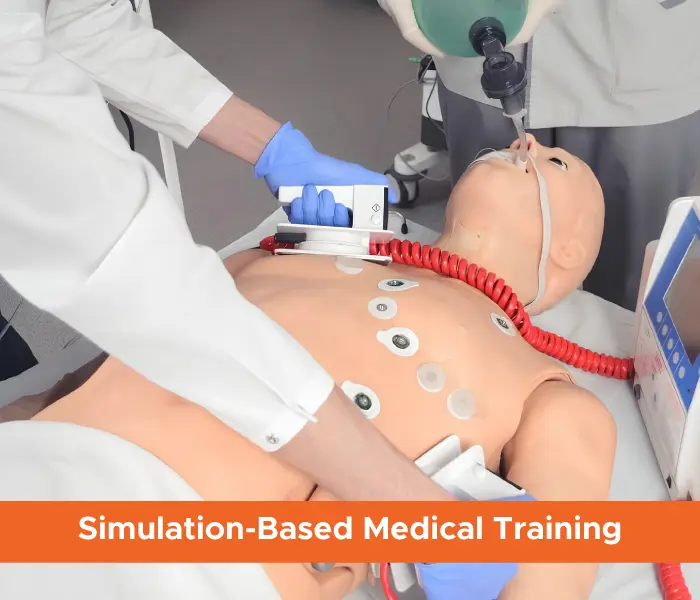
The healthcare industry has undergone a paradigm shift, emphasizing not only theoretical knowledge but also practical competence. Among the most transformative advancements in medical education is the integration of simulation-based training. This technique provides a risk-free, interactive, and immersive learning experience, significantly improving clinical skills, decision-making, and patient outcomes. Simulation is now a critical component of modern medical training across various disciplines, from emergency care to advanced surgical procedures.
Understanding Simulation in Medical Training
Simulation-based medical education involves replicating clinical scenarios using high-fidelity manikins, virtual reality systems, or standardized patients to mimic real-life conditions. These simulations allow healthcare professionals and students to practice procedures, communication, and critical thinking in a controlled environment. The training is structured to mirror the complexities and unpredictability of actual clinical settings, thereby offering experiential learning without jeopardizing patient safety.
There are various types of medical simulations:
Task trainers for practicing specific procedures (e.g., intubation or IV placement).
High-fidelity manikins that replicate human physiology and responses.
Virtual reality simulators that create digital representations of surgeries or emergency care.
Standardized patients, trained individuals who portray real patient cases.
This diversity in simulation modalities enables tailored learning for medical students, nurses, paramedics, and physicians at different stages of their careers.
The Growing Need for Simulation-Based Training
The healthcare environment is increasingly complex, with evolving technologies, diseases, and treatment protocols. Consequently, the traditional "see one, do one, teach one" model is no longer sufficient or ethically appropriate in many scenarios. Simulation bridges the gap between theoretical learning and clinical application. It allows for:
Repetition of procedures for mastery.
Exposure to rare or high-risk situations.
Development of interprofessional communication.
Immediate feedback and debriefing.
With patient safety being paramount, simulation ensures that learners can make mistakes and learn from them without real-world consequences.
Key Benefits of Simulation-Based Medical Training
1. Enhanced Patient Safety
By allowing clinicians to practice and refine their skills without putting patients at risk, simulation contributes directly to safer healthcare delivery. Errors can be identified and corrected in the learning phase, not at the bedside.
2. Skills Acquisition and Retention
Simulation enables hands-on practice, which helps learners retain knowledge more effectively than traditional lecture-based methods. It promotes muscle memory, critical thinking, and confidence in performing tasks under pressure.
3. Real-Time Feedback and Reflective Learning
Debriefing sessions following a simulation are integral to learning. Instructors provide immediate feedback, guiding participants through their performance, decisions, and areas of improvement.
4. Teamwork and Communication
Many simulations focus on interprofessional collaboration. These sessions improve communication between team members, helping reduce medical errors and improving patient outcomes.
5. Preparedness for Uncommon Scenarios
Some clinical emergencies are rare, but when they occur, prompt and precise action is critical. Simulation offers exposure to these scenarios, preparing healthcare workers for any eventuality.
6. Standardized Assessment
Simulation provides a consistent environment to evaluate the competencies of trainees. Unlike clinical rotations where exposure may vary, simulation ensures all learners experience the same situations and are assessed on identical parameters.
Applications Across Medical Fields
Simulation-based training has found its way into almost every field of healthcare, significantly enhancing the quality of care delivered. Some prominent applications include:
Emergency and Critical Care
Emergency medicine demands rapid decision-making and procedural expertise. Simulation prepares professionals for high-pressure scenarios such as cardiac arrest, stroke, trauma, and respiratory failure. Through mock code blues and rapid response team drills, clinicians sharpen their lifesaving skills.
Cardiopulmonary Resuscitation (CPR) and Advanced Life Support
Simulation is integral in training for life-saving interventions like Basic Life Support (BLS), Advanced Cardiovascular Life Support (ACLS), and Pediatric Advanced Life Support (PALS). These courses rely heavily on scenario-based learning to instill correct response patterns in emergencies.
Anesthesiology
In anesthesiology, where minute errors can lead to life-threatening outcomes, simulation is used to train professionals on airway management, drug administration, and monitoring techniques.
Obstetrics and Gynecology
Simulated deliveries and obstetric emergencies like postpartum hemorrhage or shoulder dystocia provide obstetricians, nurses, and midwives with critical experience before facing real-life patients.
Surgery
Virtual reality and high-fidelity simulators are now widely used in surgical training. These platforms allow for repetitive practice of laparoscopic, robotic, and open procedures, fostering skill development before actual operations.
Nursing and Paramedicine
Nurses and emergency responders benefit immensely from simulations that focus on triage, wound care, patient communication, and emergency stabilization.
Simulation Training in India
India has witnessed a growing recognition of simulation-based training in recent years, particularly with the rising demand for high-quality emergency and critical care education. One institution that stands out in this arena is IIEMS (Indian Institute of Emergency Medical Services).
Who is IIEMS?
IIEMS is a leading International Training Centre (ITC) accredited by the American Heart Association (AHA). It specializes in delivering AHA-certified programs that are recognized globally for their excellence and rigor. The institute's mission is to elevate the standards of emergency medical training in India, ensuring that healthcare professionals are equipped with world-class life-saving skills.
IIEMS Course Offerings
At IIEMS, a wide array of AHA-certified programs are offered, including:
Heartsaver® First Aid CPR AED – Tailored for laypersons, this course provides essential skills to respond to emergencies like choking, sudden cardiac arrest, or bleeding.
Basic Life Support (BLS) – Designed for healthcare providers, the BLS course trains participants in high-quality CPR, team dynamics, and AED usage.
Advanced Cardiovascular Life Support (ACLS) – This advanced program focuses on managing cardiovascular emergencies such as arrhythmias, stroke, and cardiac arrest with an emphasis on systematic assessments and team roles.
Pediatric Advanced Life Support (PALS) – Targeted at professionals handling pediatric emergencies, PALS trains participants in managing critical situations in children and infants.
Training Infrastructure and Reach
IIEMS has developed a strong presence across Kerala, with training centers in Kottayam, Trivandrum, Kochi, Tamil Nadu, Hyderabad and Bangalore. Each center is equipped with cutting-edge simulation labs, high-fidelity manikins, and multimedia learning tools. Their facilities create a realistic environment for participants to practice and perfect essential emergency response techniques.
What sets IIEMS apart is not just its infrastructure but also its exceptionally trained faculty. Their instructors undergo regular updates and assessments aligned with the latest AHA protocols. Many of them bring international teaching and clinical experience, making IIEMS one of the most sought-after centers for life support training in the country.
Commitment to Excellence
IIEMS is committed to not just training individuals but transforming the healthcare landscape of India through excellence in emergency preparedness. The institute collaborates with hospitals, medical colleges, corporate healthcare providers, and government bodies to deliver customized training programs tailored to diverse needs.
By setting a high benchmark in simulation-based medical education, IIEMS is actively contributing to a better-equipped, confident, and responsive healthcare workforce.
Future of Simulation-Based Training
As healthcare continues to evolve, so will the tools and techniques used in training. Some future trends include:
Integration of Artificial Intelligence (AI)
AI-driven simulations will offer adaptive learning, where the complexity of scenarios can be modified in real-time based on the learner's performance. AI can also assist in providing objective performance analytics.
Virtual and Augmented Reality (VR/AR)
VR and AR are expanding the horizons of simulation. From anatomy exploration to performing virtual surgeries, these tools are offering more immersive and scalable training environments.
Remote Simulation Training
With telemedicine becoming mainstream, simulation training is also moving online. Remote or hybrid simulations using cloud-based platforms are making high-quality training accessible in rural and underserved regions.
Personalized Learning Paths
As simulation software becomes more sophisticated, it will offer personalized scenarios based on a learner’s previous assessments, fostering a more tailored and efficient learning journey.
Finally
Simulation-based medical training represents a quantum leap in how we prepare healthcare providers for real-world challenges. It enhances competency, builds confidence, and ultimately leads to better patient outcomes. As the demands on healthcare systems grow, so does the need for smarter, safer, and more effective training methodologies.
Institutions like IIEMS exemplify the potential of simulation-based education in transforming India’s medical landscape. Through their commitment to quality, global standards, and innovation, they are not only equipping professionals with critical skills but also instilling a culture of excellence in emergency care.
The future of medicine hinges not just on advancements in technology or pharmaceuticals but on the capabilities of those who deliver care. And simulation, without a doubt, is the bridge between learning and lifesaving.