Support Email : courses@iiems.in
  Kottayam, Ernakulam, Trivandrum, Tamil Nadu Support Email : courses@iiems.in Kottayam, Ernakulam, Trivandrum, Tamil Nadu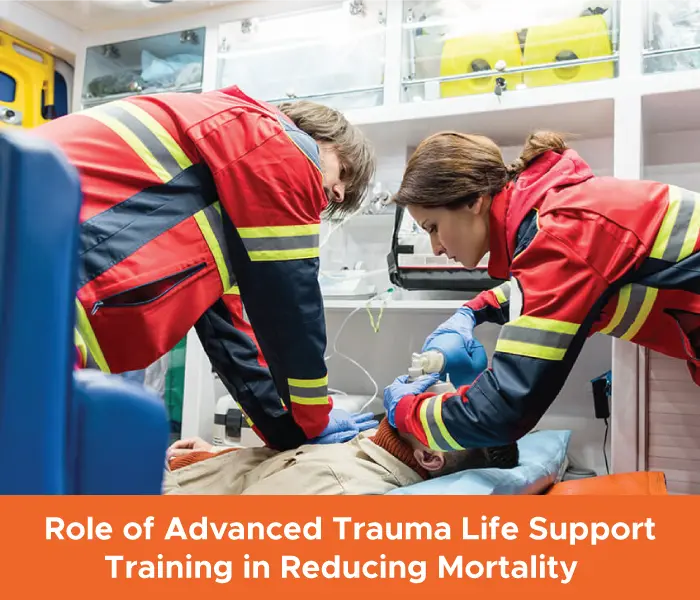
Trauma remains a leading cause of death and disability across the world. From road traffic injuries to falls and industrial accidents, trauma contributes significantly to mortality — especially in low- and middle-income countries where emergency care systems are still developing. Effective trauma care requires not only equipment and facilities but, critically, trained healthcare providers who can rapidly assess and manage life-threatening injuries in a structured and evidence-based way.
At the core of global trauma education is Advanced Trauma Life Support (ATLS) — a standardized training program developed by the American College of Surgeons (ACS) to improve the care of injured patients. IIEMS offers ATLS training as part of its trauma education programs, equipping doctors and emergency responders with vital knowledge and skills to save lives in critical situations.
Advanced Trauma Life Support (ATLS) is a systematic approach to the initial care of trauma patients developed by the ACS. Originally designed to support physicians who may not frequently manage severe trauma, ATLS provides a concise and reproducible method for evaluating and treating injured patients during the first critical minutes after injury.
The core principle of ATLS is to identify and treat the greatest threats to life first, even before a definitive diagnosis is made. The program emphasizes a structured assessment system commonly remembered by the mnemonic ABCDE:
Participants develop both cognitive and practical skills, including airway management, shock resuscitation, chest trauma care, and neurological assessment. At IIEMS, ATLS is conducted through classroom teaching and simulation-based training under the ACS trauma education framework.
In trauma cases, the window for life-saving decisions is extremely narrow. Many preventable deaths occur within the first hour after injury due to missed injuries, delayed airway management, or poor prioritization. ATLS introduces a universal, step-by-step approach that ensures rapid identification and management of life-threatening conditions.
Strong evidence supports the effectiveness of ATLS training. A retrospective matched case-control study from a tertiary care center in Kenya demonstrated a reduction in 30-day mortality from 17% before ATLS implementation to 6% after training.
Another cohort study reported that preventable deaths decreased from 30% to 15% following ATLS training. These improvements reflect enhanced clinical skills, decision-making, and adherence to standardized protocols.
ATLS goes beyond theoretical knowledge by strengthening clinical judgment and confidence. Trained providers share a common language and structured approach, leading to faster prioritization, improved airway and shock management, and fewer diagnostic errors.
ATLS-trained clinicians are also better equipped to lead multidisciplinary trauma teams, coordinate care efficiently, and make rapid, high-stakes decisions in emergency environments.
Although developed in high-income countries, ATLS principles are highly effective in resource-limited settings. Evidence from low- and middle-income regions demonstrates that structured assessment and rapid intervention alone can significantly improve trauma outcomes, even when advanced resources are limited.
The Indian Institute of Emergency Medical Services (IIEMS) is a leading emergency medical education provider in India, offering ATLS courses accredited through the American College of Surgeons.
With training centers across Kerala, including Kottayam, Kochi, and Trivandrum, IIEMS is committed to strengthening emergency care capabilities throughout India.
Trauma care is part of a larger emergency response continuum that includes pre-hospital care, triage, transport, and definitive treatment. ATLS integrates seamlessly with programs such as PHTLS and ITLS, ensuring continuity of care from the accident scene to the emergency department.
IIEMS provides comprehensive trauma education across this entire continuum, helping improve patient outcomes at every stage of care.
Advanced Trauma Life Support (ATLS) training plays a pivotal role in reducing trauma-related mortality by providing a standardized, evidence-based approach to emergency care. Research consistently shows that ATLS improves early decision-making, reduces preventable deaths, and enhances overall trauma management.
For healthcare professionals in India and beyond, earning ATLS certification through IIEMS is not just a professional milestone — it is a commitment to safer emergency care systems and stronger, more resilient communities. With trauma remaining a leading global cause of death, ATLS training is truly a lifesaving investment.