Support Email : courses@iiems.in
  Kottayam, Ernakulam, Trivandrum, Tamil Nadu Support Email : courses@iiems.in Kottayam, Ernakulam, Trivandrum, Tamil Nadu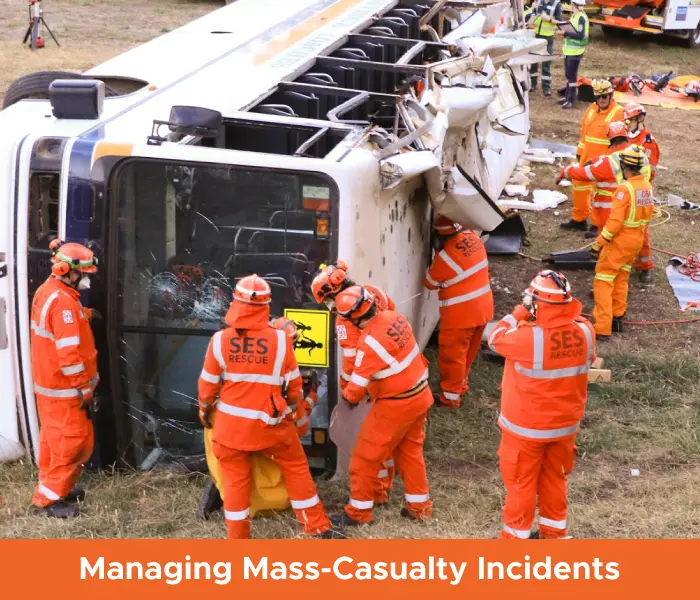
When a mass casualty incident occurs, the first few minutes define the outcome. For Indian first responders—often the first to face overwhelming scenes—quick assessment, clear communication, and efficient triage are vital. India’s diverse geographical regions and population density make MCIs frequent across highways, factories, public events, and disaster-prone areas.
This guide draws on the expertise of the Indian Institute of Emergency Medical Services (IIEMS) and national guidelines to provide a practical, India-focused approach to managing MCIs. It helps responders act with confidence, prioritise victims effectively, and support coordinated emergency operations.
An MCI is an event that produces more patients than local resources can manage using routine procedures. In India, this may include highway bus pile-ups, industrial chemical leaks, or urban explosions. The challenges include multiple casualties, diverse injuries, resource shortages, damaged infrastructure, and crowd chaos.
IIEMS emphasises its Disaster Management training (including ADLS – Advanced Disaster Life Support) to equip personnel with systems-based skills, including mass casualty information systems. A structured approach prevents confusion, minimises loss of life, and optimises use of limited resources.
Below, we unpack each phase with practical guidance.
Institutions like IIEMS provide training in trauma care, disaster life support, EMT skills, and pre-hospital care. Responders must be trained not only in BLS/ACLS but also mass-casualty triage, communication, and coordination.
Know local availability of ambulances, stretchers, first-aid kits, decontamination tools, communication devices, and hospital contacts. Maintain updated resource lists.
The National Disaster Management Authority (NDMA) provides “Incident Response System” (IRS) guidelines to streamline multi-agency coordination at district and state levels.
Regular drills sharpen readiness. Community-level training is crucial as laypersons often arrive first on scene.
Ensure the scene is safe from active threats (fire, chemical leaks, collapse). Estimate casualties, identify hazards, and establish zones (hot, warm, cold) when necessary.
Triage is the backbone of MCI management. Practical steps:
Focus on airway, breathing, and circulation. Control major haemorrhage quickly using pressure or tourniquets. Provide oxygen when available, stabilise fractures, and move casualties to treatment zones.
Establish roles: incident commander, medical team leader, liaison officer. Indian IRS guidelines highlight the importance of unity of command and clear terminology.
Set up staging areas for ambulances and logistics. Manage stretchers, medical supplies, and staff deployment.
Transport Red-tagged casualties first, followed by Yellow, and then Green. The goal is quick scene clearance to maintain control.
Select the right vehicle and notify hospitals of casualty numbers and injury types. Maintain coordination to avoid overwhelming a single facility.
Log each patient’s triage category, treatments, destination, and departure time for accountability and hospital readiness.
Continue airway management, bleeding control, and monitoring. Re-triage if patient condition changes.
Alert hospitals early with casualty estimates. This allows mobilisation of emergency teams, blood banks, and equipment.
Hospitals must activate their disaster plans, expand triage areas, and secure supplies. Responders should hand off care with clear briefing.
Psychological first aid is essential for victims, families, and responders. Indian guidelines emphasise early mental health support.
Clear equipment, ensure all casualties are accounted for, and formally close the scene.
Conduct a “hot debrief” immediately and a detailed session later to analyse strengths and weaknesses.
Maintain detailed records to support improvement, audits, and future training.
Use findings to enhance protocols and future drills. IIEMS strongly emphasises continuous education.
IIEMS delivers high-quality emergency medical and disaster response training, including BLS, ACLS, EMT, trauma care, and disaster life support (e.g., ADLS). These programmes equip responders with:
Partnering with IIEMS strengthens India’s emergency preparedness across agencies.
Mass casualty incidents demand preparedness, clarity, and organised action. With structured protocols and confident decision-making, Indian first responders can significantly reduce fatalities.
IIEMS plays a crucial role in equipping responders with international-standard training, practical skills, and hands-on drills. As India continues to face diverse emergencies, strengthening responder capacity through IIEMS-led training is essential for building a more resilient emergency response system.