Support Email : [email protected]
  Kottayam, Ernakulam, Trivandrum, Tamil Nadu Support Email : [email protected] Kottayam, Ernakulam, Trivandrum, Tamil Nadu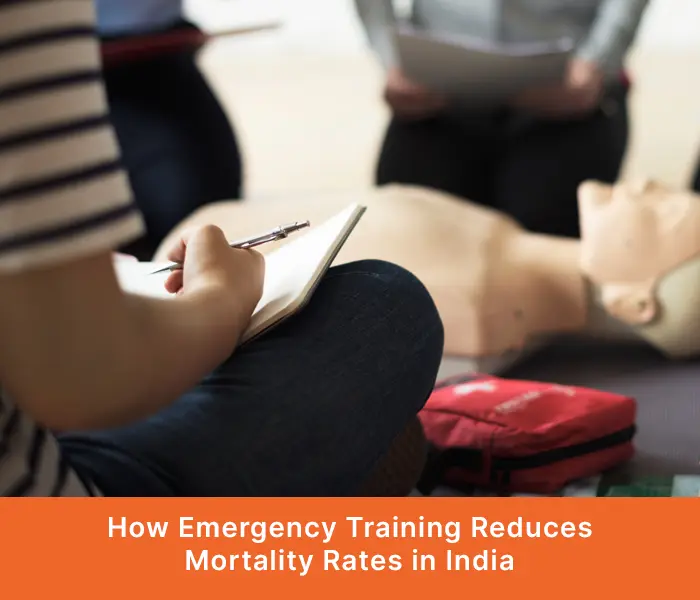
India witnesses a large number of deaths that occur due to heart attacks, road accidents, trauma, and various other emergencies. One of the key reasons for these deaths is the absence of immediate action in the golden hour – this crucial period post-emergency wherein an immediate response from the surroundings is very valuable. Emergency training plays an important role in decreasing such deaths through CPR, First Aid, and BLS training.
The Current Challenge in India
One of the leading causes of death in India is the out-of-hospital cardiac arrest (OHCA). OHCA occurs when there is sudden cardiac arrest that happens outside of a hospital setting. The survival rates for OHCA patients are generally less than 10% in India, with bystander CPR rates being extremely low at between 1.3% to 9.8%.
Road accidents and trauma patients are also some of the biggest contributors to the rising death rate in India. Trauma is considered one of the biggest causes of mortality in developing nations.
The Significance of Emergency Training
Emergency training ensures that people are ready to respond appropriately in any situation that poses a threat to their lives. It has been documented that early CPR and swift intervention can increase one’s chance of survival following cardiac arrest by at least two or three times.
Not only does training improve one’s skills, but it also increases their level of confidence. Those who receive CPR training feel that they will be able to handle themselves properly if and when an emergency strikes.
Evidences Based on Medical Research
The effectiveness of structured emergency training can easily be seen in the medical field. In a study carried out in India, it was discovered that survival rates for cardiac arrest patients were considerably enhanced among those whose nurses had been trained in CPR. The survival rate rose from 27.5 percent without training to 52.9 percent with training.
Impact at Community Level
Mass training exercises in various parts of India have been yielding positive results. In one instance of national mass awareness campaigns on CPR, more than 6 lakh persons received training for performing life-saving maneuvers. The goal is to develop a pool of trained manpower who can be relied upon to provide emergency support services in case of any emergency.
Cities such as Kochi have witnessed a surge in the number of trainees, including students, workers, drivers, and others, becoming capable enough to handle cardiac emergencies.
“Golden Hour” Concept
Perhaps one of the most crucial aspects of an emergency situation is the need for immediate response as delay may prove fatal. Emergency training is essential because:
- Victims receive CPR before ambulance arrival
- Bleeding is controlled in trauma cases
- Airway and breathing are maintained
- Panic is replaced with structured action
In a scenario where there is no emergency training, victims become vulnerable to death or permanent damage.
Role of Institutions such as IIEMS
Organizations such as IIEMS are key in ensuring that there is an effective connection between emergencies and action. Through organized training programs and certifications, these organizations can help create a knowledgeable community that can save lives.
Emergency training programs offered by such institutions include:
- Cardiopulmonary resuscitation (CPR) and Automated External Defibrillator (AED)
- Response to trauma and accidents
- First aid skills for emergencies
- Disaster preparedness
These training programs aim to ensure that people are not only educated but also trained on how to respond to emergencies.
Barriers to Emergency Training in India
While there are many advantages of emergency training, it also faces some barriers in India. Some of these include:
- Limited awareness among the public
- Fear of consequences
- Limited access to emergency training programs
- Not incorporated in educational curriculum
Pathway to Success
For reducing the mortality rate in India, there is a need for India to take the following steps:
- CPR and first aid training should be made compulsory at school and college levels
- There should be workplace emergency training courses
- Public awareness campaigns should be launched in full swing
- There should be AEDs installed in public places
- Community responders networks should be encouraged
When a greater number of people get educated about CPR, it helps enhance their chances of saving their lives.
Conclusion
Emergency training is not just a skill — it is a life-saving responsibility. In a country like India, where emergency response gaps still exist, empowering individuals with basic medical knowledge can make a big difference.
By investing in widespread emergency training, organizations like IIEMS are not only educating people but also building a safer, more prepared society. Every trained individual becomes a potential lifesaver, helping reduce mortality rates and creating a stronger, more resilient nation.
Faq
1. What is the “golden hour” in emergency situations?
The golden hour refers to the first hour after a medical emergency such as a heart attack, accident, or trauma. Immediate care during this time significantly increases the chances of survival and reduces long-term complications.
2. What is OHCA (Out-of-Hospital Cardiac Arrest)?
OHCA is a sudden cardiac arrest that occurs outside a hospital setting. It is one of the leading causes of death in India, mainly due to delayed response and low awareness of CPR among the public.
3. How effective is bystander CPR in saving lives?
Bystander CPR can double or even triple a person’s chances of survival after cardiac arrest. However, in India, the rate of bystander CPR is still very low, making awareness and training crucial.
4. Who can learn emergency response skills?
Anyone can learn emergency response skills, including students, employees, drivers, homemakers, and senior citizens. No prior medical knowledge is required.
5. Why is emergency training important in India?
India faces a high number of deaths due to heart attacks, road accidents, and trauma. Emergency training helps bridge the gap between the incident and medical assistance, improving survival rates.