Support Email : courses@iiems.in
  Kottayam, Ernakulam, Trivandrum, Tamil Nadu Support Email : courses@iiems.in Kottayam, Ernakulam, Trivandrum, Tamil Nadu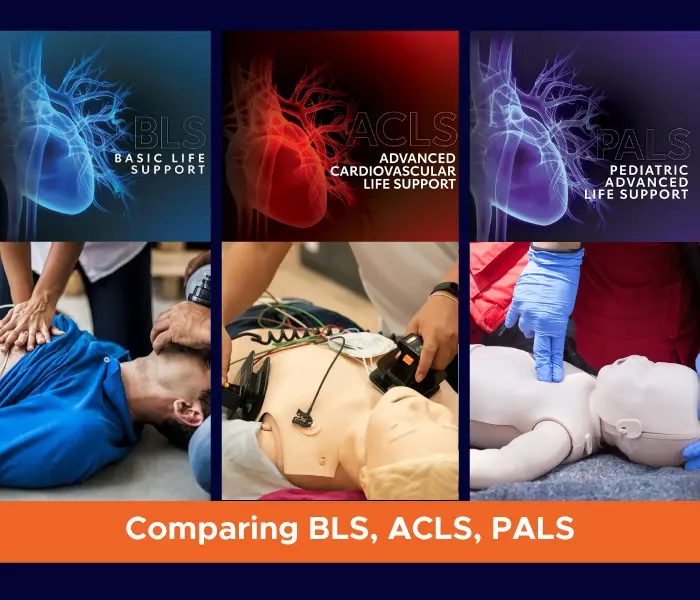
Medical emergencies are unpredictable. A sudden cardiac arrest, respiratory failure, or pediatric emergency can happen anytime — in hospitals, clinics, ambulances, workplaces, or public spaces. In such moments, trained professionals become the difference between survival and tragedy. This is where life support training plays a vital role.
At the Indian Institute of Emergency Medical Services (IIEMS), healthcare professionals receive globally recognized, American Heart Association (AHA) certified training in BLS, ACLS, and PALS. While these courses are often grouped together, each serves a unique purpose and is designed for specific clinical responsibilities.
If you’re unsure which life support course to choose, this guide will help you understand the differences, benefits, and ideal candidates for each — so you can make an informed decision for your career and patient care.
Basic Life Support (BLS) is the primary certification for anyone who may encounter cardiac, respiratory, or choking emergencies — whether inside a hospital or in the community. A BLS course equips you with essential life-saving skills that are foundational in emergency medical care.
Early, high-quality CPR and rapid defibrillation are the most important interventions for survival during cardiac arrest.
Without BLS training, advanced life support courses like ACLS and PALS are not accessible, as they build upon BLS fundamentals.
Advanced Cardiovascular Life Support (ACLS) focuses on managing complex cardiac and respiratory emergencies in adults. It emphasizes critical thinking, leadership, and advanced interventions during high-stress clinical situations.
If your role involves adult cardiac emergencies or leading resuscitation teams, ACLS is the next step after BLS.
Pediatric Advanced Life Support (PALS) focuses on emergency care for infants and children, whose physiology and responses differ significantly from adults.
| Feature / Skill | BLS | ACLS | PALS |
|---|---|---|---|
| Primary Focus | Basic emergency care | Advanced cardiac care | Pediatric emergency care |
| CPR & AED | ✔️ Core focus | ✔️ Included | ✔️ Pediatric focused |
| Airway Management | Basic | Advanced | Pediatric-specific |
| Medications | ❌ | ✔️ Cardiac drugs | ✔️ Pediatric drugs |
| ECG Interpretation | ❌ | ✔️ Yes | ✔️ Pediatric rhythms |
| Target Audience | All healthcare & responders | Critical care teams | Pediatric care providers |
IIEMS is an AHA-authorized International Training Centre offering world-class life support training across Kerala and India.
Emergency preparedness is more than a certification — it’s a commitment to saving lives. Understanding BLS, ACLS, and PALS helps you choose the right training path aligned with your professional responsibilities.
At IIEMS, we empower healthcare professionals with skills that truly matter — grounded in international standards and practical expertise.